
What Is Explainability in Generative AI?
For those who want to use generative AI in research, academic writing, business, or analysis while being able to explain why a particular output was produced
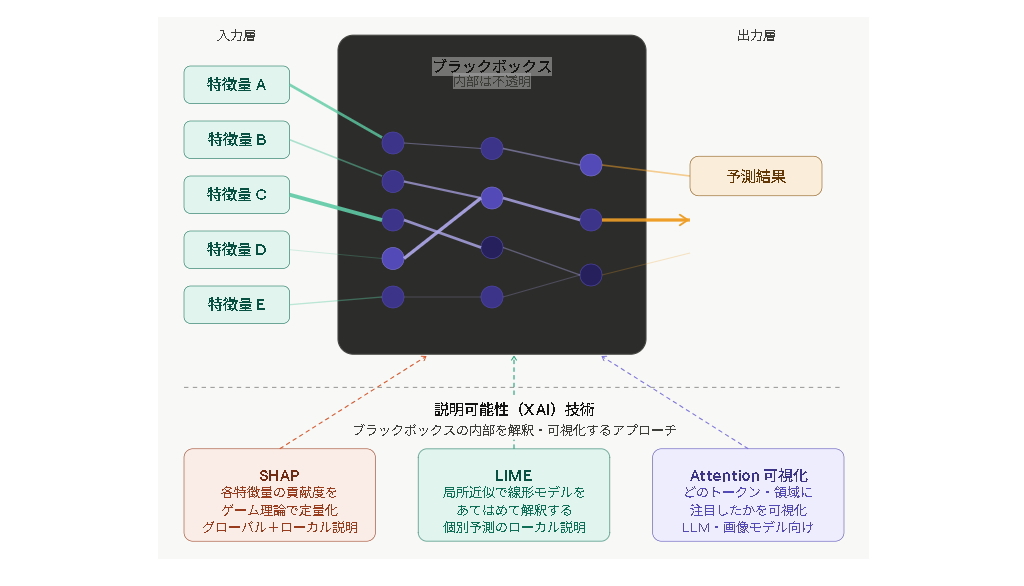
Generative AI systems such as ChatGPT are now used for writing, summarization, translation, document preparation, programming, data analysis, academic-writing support, and many other tasks. However, even when an AI answer looks plausible, "why did it reach that conclusion?", "what evidence supports it?", and "how can errors be checked?" are often difficult to see.
A concept closely related to this problem is explainability in generative AI . Explainability is the idea that users and stakeholders should be able to understand the reasons, evidence, limitations, and decision process behind an AI output. In fields such as research, healthcare, education, government, finance, human resources, law, marketing, statistical analysis, and academic writing, AI output should not simply be trusted; instead, it is important that humans can verify it in an explainable form .
This article is intended for readers considering generative AI explainability、 AI explainability、 generative AI transparency、 Explainable AI、 XAI、 AI governance、 AI accountability、 hallucination mitigation、 RAG generative AI For readers searching for topics such as these, this article explains the meaning and importance of explainability in generative AI, practical verification points, and cautions for research and academic use.
The first point to understand is that Generative-AI explainability is not as simple as merely asking the AI to explain its reasoning . An explanation generated afterward by AI does not necessarily represent the actual process by which the output was produced. An explainable workflow therefore needs to combine the output itself, source materials, prompts, referenced data, verification procedures, and human review.
- • What Is Explainability in Generative AI?
- • Why Generative AI Needs Explainability
- • Five Perspectives to Check for Generative-AI Explainability
- • Relationship Between Hallucinations and Explainability
- • Improving Explainability with RAG and Citation Verification
- • Cautions When Using Generative AI for Research and Academic Writing
- • AI Governance Requirements for Business Use
- • Checklist for improving explainability
- • Explainability of generative AI in statistical analysis and data analysis
- • Examples of statements on generative AI explainability
- • Common problematic expressions when using generative AI
- • AI utilization support available from Stat Agent
- • Frequently Asked Questions
- • Summary
What is explainability in generative AI?
Explainability in generative AI refers to a state in which users can understand, for AI-generated text, summaries, analysis results, recommendations, judgments, classifications, code, documents, and other outputs, what inputs they were based on, what evidence was referenced, and what limitations the outputs have. In other words, rather than accepting generative AI responses merely as results, explainability is the practice of organizing the background and verifiable evidence that led to those results.
For example, if generative AI responds that “qualitative analysis is appropriate for this study,” it should be possible to explain the reason in terms of the research objective, the data being analyzed, sample size, interview content, and consistency with the research question. Likewise, references and statistical methods suggested by AI must be checked by humans for their existence, conditions of applicability, and validity of interpretation.
Differences among transparency, explainability, and accountability
In discussions of generative AI, the terms transparency, explainability, and accountability are sometimes conflated. Transparency means making clear that AI is being used, what data or mechanisms it may rely on, and the scope in which AI was used. Explainability means being able to explain the reasons or evidence for AI outputs in a form that users and third parties can understand. Accountability means clarifying who verifies and who bears responsibility for decisions and deliverables arising from the use of AI.
For example, when generative AI is used in writing a paper, transparency alone—simply stating that “AI was used”—is not sufficient. It should also be possible to explain which parts used AI, how the output was checked, and who verified the accuracy of references and numerical values.
Why generative AI is harder to explain than conventional AI
With conventional machine-learning models, it may be possible to explain how much input variables affected predictions using feature importance, regression coefficients, or similar measures. Generative AI, by contrast, produces text, images, code, and other content, so outputs tend to be long and complex, making it difficult to explain simply which information influenced which expression.
Moreover, because generative AI probabilistically produces natural-sounding content, it can generate explanations that appear plausible but are factually incorrect. Therefore, explainability for generative AI must address not only the internal mechanism of the AI but also the ability to explain the source materials, prompts, generated outputs, and human verification procedures. .
Why generative AI needs explainability
Generative AI needs explainability because its outputs can influence human judgment, research findings, business documents, educational assessment, customer service, and decision-making. Using unexplained AI output as-is can lead to misinformation, unsupported judgments, copyright or personal-information issues, inappropriate discrimination, and unclear responsibility.
In research and academic writing in particular, unsupported statements, nonexistent references, incorrect statistical methods, or logical leaps can undermine the credibility of the entire study. In business settings as well, errors in AI-generated proposals, reports, contracts, analytical reports, or customer-facing text may affect an organization’s reputation.
Accordingly, when using generative AI, the goal should not be “it is correct because AI produced it,” but rather a state in which you can show “what evidence it is based on and how far humans have verified it.” This state needs to be established.
Five perspectives to check for generative AI explainability
When considering the explainability of generative AI, it is important to examine not only the output itself but also the inputs, reference information, generation process, verification methods, and intended use. Organizing the following five perspectives makes it easier to improve the transparency and reproducibility of AI use.
| Perspective | What to check |
|---|---|
| Input | What prompts, conditions, and materials were provided to the AI |
| Evidence | Which literature, data, internal documents, or facts the AI response is based on |
| Output | Whether the generated text, analysis, summary, or proposal contains errors or unsupported leaps |
| Verification | How humans performed fact-checking, reference verification, and numerical checks |
| Responsibility | Who is responsible for final decisions, publication, submission, and delivery |
Explainability of inputs and prompts
Generative AI output is strongly affected by the prompts provided. Therefore, when generative AI is used for important business or research tasks, it is useful to keep a record of the instructions given. For example, an instruction such as “summarize this for beginners” will produce content with a different level of detail and technical sophistication from “write this as the Methods section of a peer-reviewed paper.”
Keeping a record of prompts makes it easier to review later why a particular output was produced. In organizations where multiple people use AI, standardizing or templating prompts can also reduce variability in output quality.
Explainability of outputs and supporting materials
Generative AI responses may not explicitly identify their evidence. Therefore, when using them in research or business, it is necessary to distinguish what source material supports the output, which parts are AI inference, and which parts are verified facts.
In literature reviews, laws and regulations, medical information, statistical analysis, financial analysis, contracts, educational assessment, and similar areas, it is essential not to accept AI answers as-is but to check original sources, official documents, primary materials, datasets, analysis code, and calculation results.
Relationship between hallucination and explainability
One of the major risks of generative AI is hallucination. Hallucination is the phenomenon in which AI generates false or nonexistent information in a plausible manner. Examples include nonexistent papers, incorrect author names, fabricated statistical results, incorrect laws or regulations, fictitious URLs, and inaccurate company information.
Hallucinations are problematic because they often look natural in written form, making errors difficult for users to notice. Therefore, improving explainability requires not merely asking AI to explain its reasons, but also checking source materials, verifying citations and numerical values, and having humans validate the output.
In particular, for undergraduate theses, master’s theses, journal submissions, research proposals, statistical analysis reports, and writing in medicine, nursing, welfare, and education, do not use AI-generated bibliographic information or technical terminology without verification. .
How RAG and citation verification can improve explainability
One method for improving the explainability of generative AI is retrieval-augmented generation (RAG). RAG is a mechanism that generates responses while referring to external materials or databases. Rather than having generative AI answer on its own, it can refer to specified literature, internal documents, manuals, PDFs, databases, and other sources, making the supporting evidence easier to verify.
However, using RAG does not make a system completely safe. It is still necessary to check how source materials are selected, whether retrieval results are appropriate, whether cited passages are accurate, whether important information was omitted during summarization, and whether context was misunderstood. Even when RAG is used, humans should ultimately compare the output with the original source and organize it in an explainable form.
When generative AI is used for papers or reports, do not simply trust the evidence it presents. Check the existence of the references, author names, publication years, page numbers, DOIs, cited passages, and correspondence between the cited source and the claim. These items need to be verified.
Points to note when using generative AI for research and academic writing
Explainability is extremely important when generative AI is used for research and academic writing. Research requires consistency of evidence and logic across the research objective, prior literature, methods, results, discussion, and references. Using AI-generated text without verification can lead to incorrect references, conceptual confusion, inconsistencies in research methods, misuse of statistical techniques, and unsupported leaps in discussion.
When using generative AI as research support, it is advisable to limit its role to tasks such as brainstorming, organizing outlines, improving readability, considering literature-search keywords, comparing analysis strategies, and checking phrasing, while ensuring that researchers themselves conduct the final substantive review.
Rules governing the use of generative AI may differ among universities, academic societies, and target journals. Therefore, the scope of AI use, verification methods, author responsibility, treatment of citations, and whether data may be entered into AI systems should be checked in advance.
AI governance required for business use
When companies, municipalities, research institutions, and educational institutions use generative AI, it should be treated not merely as a convenient personal tool but within an organizational AI governance framework. AI governance means establishing rules, accountability structures, verification procedures, training, and record management so that AI can be used safely and appropriately.
For example, organizations need to clarify whether customer information or research-participant information may be entered into AI systems, whether confidential documents may be uploaded, who reviews AI-generated text, and who is responsible if misinformation is included.
For business use of generative AI, it is important to define what information may be entered, what tasks AI may be used for, who is responsible for checking outputs, how records are retained, and how customers and users are informed. These rules should be established in advance.
Checklist for improving explainability
To ensure that deliverables created with generative AI remain explainable, it is useful to conduct checks such as the following after creation. It is important to review not only whether the writing sounds natural, but also the evidence, responsibility, reproducibility, and limitations.
- Can you explain the purpose and scope of AI use?
- Have you recorded the prompts and instructions used?
- Have you checked the source materials supporting the output?
- Have you verified the existence and accuracy of references, URLs, statistical values, and proper nouns?
- Have you distinguished AI inference from verified facts?
- Have you avoided improperly entering personal or confidential information?
- Are the final reviewer and responsible person clearly identified?
- Have you described the limitations or uncertainty of AI where necessary?
Conducting these checks makes it easier to treat generative AI output not as merely automated content, but as a human-verified deliverable.
Explainability of generative AI in statistical analysis and data analysis
Explainability is also important when generative AI is used for statistical analysis and data analysis. Generative AI can suggest candidate analysis methods, create R or Python code, and explain how to read SPSS output. However, an AI-suggested method may not fit the measurement scale of the data, sample size, research objective, hypothesis, or statistical assumptions.
For example, AI may suggest comparing means for nominal-scale data, recommend an independent-samples t-test for paired data, or recommend a complex model despite a small sample size. Therefore, AI output must be checked against statistical assumptions and the research objective.
To improve explainability in data analysis, it is important to specify the reason for selecting the analysis method, how variables were handled, missing-data treatment, outlier checks, assumptions, interpretation of output, and limitations. When AI-generated code is used, humans must also understand the meaning of the code and verify the calculation results and interpretation of output tables.
Examples of statements on generative AI explainability
When generative AI is used in research or business, the scope of its use and how it was verified should be described where necessary. The following are examples of statements written with explainability in mind.
- In this manuscript, generative AI was used to assist with organizing the manuscript structure and refining expression; however, the authors selected the prior literature, verified citations, and made the final decisions regarding the argument.
- Bibliographic information suggested by generative AI was used only after verifying the existence of each source, author names, publication year, journal, and DOI.
- Generative AI was used as a supplementary aid in considering the statistical analysis strategy; however, the final analytical method was selected after confirming the measurement scale of the data, the research objective, and statistical assumptions.
- To avoid possible misinformation in AI output, the content was cross-checked against official materials, original sources, analysis code, and the original data.
- Generative AI was used to assist with drafting, while human personnel reviewed the content, accuracy, and ethical considerations of the final deliverable.
The key is not merely to state that AI was used, but to clarify where it was used, how the output was verified, and who bears responsibility.
Common problematic expressions when using generative AI
Expressions that undermine the explainability of generative AI include unsupported assertions, AI-dependent statements, missing verification procedures, and unclear responsibility. In papers and reports in particular, the greater problem is not the use of AI itself, but the use of AI output without verification.
- The AI gave this answer, so we adopted it as-is.
- The reference was included in the bibliography without checking whether it actually exists.
- The AI-recommended statistical method was used without checking its assumptions.
- Only the AI-generated summary was read; the original source was not checked.
- Confidential or personal information was entered into the AI system as-is.
- Numerical values and proper nouns generated by AI were not cross-checked.
- The scope of AI use and the person responsible for verification are unclear.
- The limitations and uncertainty of AI were not considered.
Generative AI is a highly useful support tool, but responsibility for its output cannot be transferred to the AI. Humans must review the final deliverable and put it into a state that can be explained.
AI utilization support available from Stat Agent
At Stat Agent, our support for statistical analysis, qualitative analysis, survey tabulation, text mining, research planning, academic writing, and report preparation emphasizes the explainability, transparency, evidence verification, and validation of analytical methods required in the era of generative AI.
In particular, for research support and data-analysis support involving AI, we can assist with validating AI-suggested analysis strategies, explaining why a statistical method was selected, verifying literature and source materials, organizing interpretation of results, and supporting the writing of the Methods, Results, and Discussion sections. according to the research objective and the data.
We can also provide specific consultation for concerns such as “I am not sure whether the analysis strategy created with generative AI is correct,” “I do not know whether I can use the statistical method suggested by AI as-is,” “I want to turn AI output into a form suitable for a paper or report,” “I want to check for hallucinations or fabricated references,” or “I want to make AI-assisted research support explainable.”
Frequently Asked Questions
Q1. What is explainability in generative AI?
Explainability in generative AI means that humans can understand and explain what inputs and evidence AI-generated text, analyses, recommendations, summaries, and other outputs are based on, as well as their limitations. Rather than accepting AI responses as-is, it is important to make the supporting sources and verification procedures clear.
Q2. Is explainability ensured simply by asking AI for its reasons?
No. The reasons generated by AI afterward do not necessarily reflect the actual generation process or accurate evidence. Improving explainability requires combining prompts, source materials, output review, human verification, and confirmation by a responsible person.
Q3. What is effective for preventing generative AI hallucinations?
Effective measures include verifying the existence of references and URLs, consulting official documents and original sources, cross-checking numerical values and proper nouns, and confirming AI output against multiple sources of evidence. In academic papers and research reports in particular, it is important not to cite references suggested by AI without verification.
Q4. Can generative AI be used for statistical analysis?
Generative AI can be useful for organizing candidate analysis methods, generating code, and drafting interpretations of results. However, humans must verify whether the method is appropriate for the measurement scale of the data, sample size, statistical assumptions, and research objective. Rather than adopting AI suggestions as-is, it is important to assess their statistical validity.
Q5. What should I be careful about when using generative AI for academic writing?
You should confirm the scope of AI use, verify references and citation accuracy, determine whether data may be entered into the AI system, consider research ethics, and check the rules of the target journal. Generative AI can support drafting and organization, but humans must retain responsibility for the final argument, references, analysis, and discussion.
Summary | Explainability is a prerequisite for trustworthy use of generative AI
The important point when considering generative AI and explainability is not merely to accept AI output as a “convenient answer,” but to ensure that the evidence, inputs, conditions, and limitations behind that answer can be checked. Generative AI can be highly effective for writing and analytical support, but it also carries risks such as misinformation, fabricated references, logical leaps, and misuse of statistical methods.
For generative AI explainability, transparency, evidence verification, prompt management, hallucination prevention, human verification, and clear final accountability are essential. Establishing these practices can improve the reliability of AI use in research, academic writing, statistical analysis, business-document preparation, customer service, and decision-making.
At Stat Agent, our statistical analysis, qualitative analysis, research support, academic writing support, and report-preparation support in the era of generative AI can cover validation of AI outputs,、 organization of explainable reasoning for analytical methods,、 and evidence-based writing suitable for research and business use. If you have concerns about using generative AI, please feel free to contact us.
