
Is It Appropriate to Outsource Statistical Analysis? Benefits and Cautions for Researchers Using an Analysis Service
When analysis is the only part not progressing, or when you need to organize results for publication, this guide explains how external support can be used appropriately.
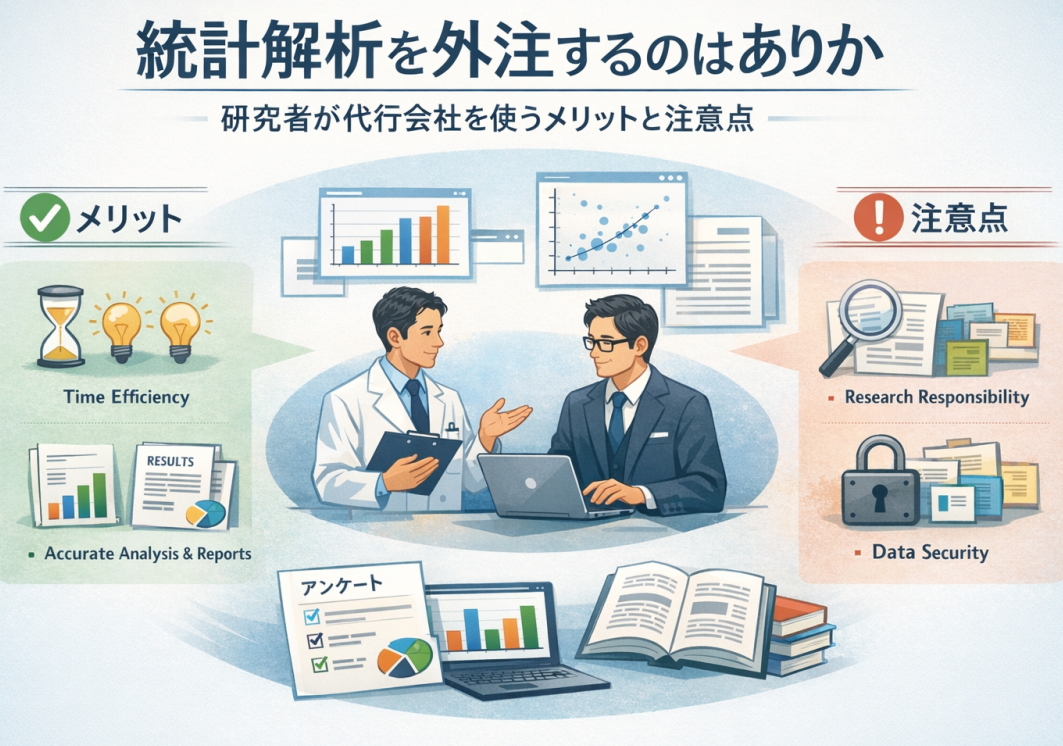
Many researchers reach a point where they feel that “the survey is complete, but I have not decided how to analyze it,” “I cannot organize the SPSS output for a paper,” or “I do not have enough time to conduct qualitative analysis of open-ended responses.”
Outsourcing statistical analysis does not mean handing off the entire research project. It isan option for supplementing specialized analytical work and preparation of figures and tables with external expertise.However, this assumes that research ethics, confidentiality, the scope of work, and the author’s accountability are clearly defined.
The key to outsourcing statistical analysis isto clearly distinguish what will be outsourced from what the researcher will decide personally..
Is outsourcing statistical analysis acceptable?
Outsourcing statistical analysis is not inherently problematic. What matters is that the researcher remains responsible for the research objective, hypotheses, meaning of the data, and validity of the conclusions, while appropriately managing the scope of external support.
An external provider can perform analyses, create figures and tables, organize results, and assist with explanations of methods, but final research judgments and claims must be made by the researcher.
Benefits of outsourcing
- Reduces the risk of selecting an inappropriate analytical method
- Reduces the operational burden of SPSS, EZR, R, and other software
- Makes it easier to prepare tables and figures in publication-ready formats
- Facilitates checks of missing data, outliers, scale scoring, and related issues
- Allows researchers to spend more time on discussion and publication preparation
In medicine, nursing, psychology, education, social welfare, and management in particular, research is often conducted alongside clinical work, teaching, or other professional duties, increasing the value of analytical support.
Cautions when outsourcing
Important considerations include research ethics, personal information, confidentiality, data anonymization, and a clearly defined analytical scope. When data contain personal information, anonymization and a nondisclosure agreement should be considered as appropriate.
It is also important not to use outsourced results uncritically, but to confirm that they align with the research objective and that the interpretation is valid.
Materials to prepare before requesting support
| Research objective and hypotheses | What the study aims to determine and what the primary outcome is |
|---|---|
| Data files | Excel, CSV, SPSS, or other files, together with variable names and data-entry rules |
| Questionnaire and scale information | Question wording, response options, reverse-scored items, and how scale scores are calculated |
| Desired deliverables | Summary tables, graphs, publication tables, explanatory text for analysis results, reports, etc. |
| Target publication information | Author guidelines, word limits, formatting rules, reviewer comments, etc. |
What can be outsourced?
Statistical analysis, tabulation, graph creation, factor analysis, regression analysis, logistic regression, classification of open-ended responses, text mining with KH Coder, and creation of publication-ready figures and tables are common areas for external support.
By contrast, the researcher must retain responsibility for the study’s conclusions, ethical judgments, authorship responsibilities, and final decision to submit.
Criteria for choosing an analysis service provider
When choosing a provider, it is important to consider not only price but also understanding of the research field, deliverable formats, confidentiality arrangements, revision support, and clarity of explanations.
Choosing a provider that can explain results in relation to the research objective, rather than merely “producing analysis output,” leads to deliverables that are easier to use in papers and reports.
Frequently Asked Questions
Q1. Is outsourcing statistical analysis acceptable from a research-ethics perspective?
It is important to define the scope of external support clearly and for the researcher to remain responsible for the study and conclusions. Confidentiality arrangements and anonymization should be used where appropriate.
Q2. Can I consult you even if the data are not yet organized?
Yes. However, the process is smoother if you have materials that clarify variable names, data-entry rules, missing values, and the meaning of scales.
Q3. Can I request only tables and figures for a journal submission?
Yes. We can support formatting of tables, figures, and captions according to the journal guidelines and existing analysis results.
Summary | Outsourcing statistical analysis can support research quality
Outsourcing statistical analysis is not a substitute for the researcher’s judgment; it is a means of supporting specialized analytical work and preparation of figures and tables.
By clearly defining the scope, confidentiality, data organization, research ethics, and required deliverables, statistical-analysis outsourcing can contribute to improved research quality.
