
Qualitative Data AnalysisQualitative Data Analysis
Major Types of Qualitative Data Analysis
This section explains qualitative data analysis in statistics and research methodology. Qualitative data analysis isa set of methods for organizing language-based and descriptive data—such as interviews, open-ended responses, observation records, and transcripts—to clarify meaning, structure, and context.Rather than comparing numerical means or proportions, it aims to deeply understand participants' experiences, perceptions, emotions, behaviors, and contexts. It is widely used in nursing, education, welfare, medical interviews, marketing research, human-resource research, and many other fields.Qualitative Data Analysis
There are several representative qualitative methods depending on the research objective and nature of the data. Each is explained below.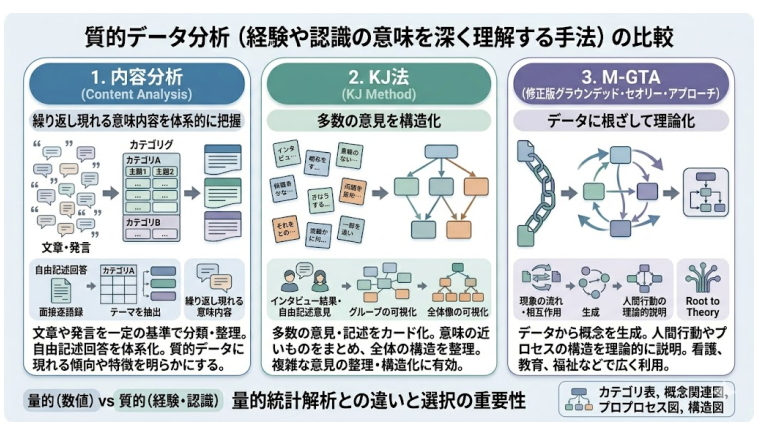
1. Content Analysis:
Content analysis classifies and organizes text or statements according to defined criteria to identify patterns and characteristics. It may be used, for example, to organize open-ended survey responses into categories or to extract recurring themes from interview transcripts. The method makes it possible tosystematically identify recurring meanings within qualitative data.It is frequently used in research papers and analysis of open-ended questionnaire responses.
2. KJ Method:
The KJ Method organizes many opinions or statements into cards and groups items with similar meanings to reveal the overall structure. It is useful, for example, when organizing interview findings or open-ended comments to visualize the overall pattern of participants' issues or needs. It is well suited to structuring complex and diverse opinions and supporting idea generation.
3. M-GTA (Modified Grounded Theory Approach):
M-GTA is a qualitative research method that generates concepts grounded in data and theoretically explains structures and processes of human behavior. It can be used to analyze processes such as patients' continuation of treatment, teachers' decision-making, or ongoing support for service users. Beyond simple classification, it isespecially effective when the goal is to understand the flow and interaction of a phenomenon theoretically.M-GTA is widely used in nursing, education, welfare, and related fields.
Unlike statistical analysis of quantitative data, qualitative methods allow deeper understanding of experiences and perceptions that are difficult to quantify. Content analysis organizes meaning, the KJ Method structures complex material, and M-GTA can generate process-oriented or theoretical explanations. Selecting a method suited to the research objective is important. Category tables, concept-relation diagrams, process diagrams, and structural diagrams are often used to visualize qualitative findings.
Content Analysis
Content analysis examines qualitative data such as text, open-ended responses, interview transcripts, and observation records by reading the material and classifying and organizing the meanings contained within it. It is a representative qualitative method used in medicine, nursing, education, management, marketing, and many other fields.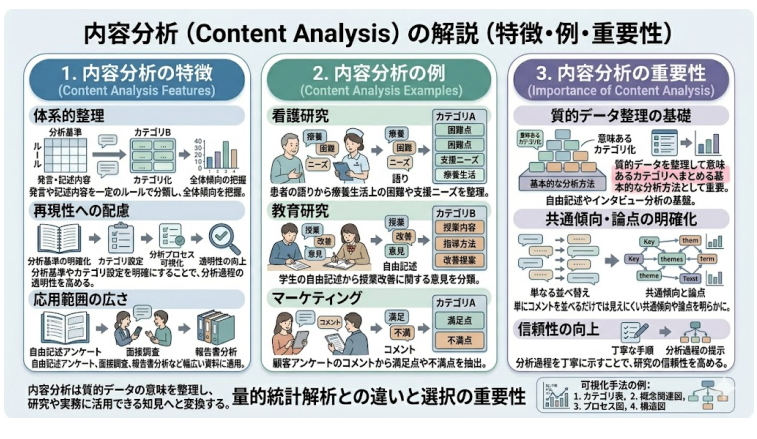
Characteristics of Content Analysis
Systematic organization: Statements and written content can be classified according to defined rules to identify overall patterns.
Attention to reproducibility: Clearly defining analytical criteria and categories improves transparency of the analytical process.
Broad applicability: The method can be applied to open-ended questionnaires, interview studies, report analysis, and many other materials.
Examples of Content Analysis
Nursing research: Organize difficulties in daily life and support needs from patients' narratives.
Educational research: Classify student open-ended comments concerning course improvement.
Marketing: Extract points of satisfaction and dissatisfaction from customer-survey comments.
Importance of Content Analysis
Content analysis is important asa basic method for organizing qualitative data into meaningful categories.It can reveal common patterns and issues that are difficult to see from a simple list of comments, making it a foundation for open-ended response and interview analysis. Carefully documenting the analytical process can also strengthen research trustworthiness.
Thus, content analysis is a representative method for organizing the meaning of qualitative data and converting it into findings useful for research and practice.
KJ Method
The KJ Method places collected opinions and statements on cards and integrates them based on similarity to identify the overall structure. It is known as a method for organizing complex qualitative data and making the overall picture easier to understand.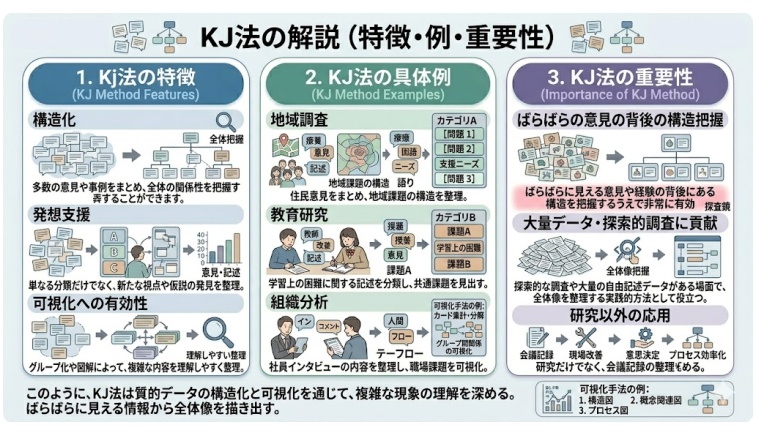
Characteristics of the KJ Method
Structuring: Many opinions or cases can be grouped to understand their overall relationships.
Idea generation: The method can support discovery of new perspectives and hypotheses, not only classification.
Useful for visualization: Grouping and diagramming help organize complex material into an understandable form.
Examples of the KJ Method
Community research: Organize residents' opinions to clarify the structure of local issues.
Educational research: Classify descriptions of learning difficulties to identify common problems.
Organizational analysis: Organize employee interviews to visualize workplace issues.
Importance of the KJ Method
The KJ Method is highly effective for organizing complex and diverse qualitative data andidentifying underlying structure in opinions and experiences that initially appear disconnected.It is particularly practical for exploratory research and settings with large volumes of open-ended responses. It can also be applied beyond research to meeting records and workplace improvement.
Thus, the KJ Method is an important approach for deepening understanding through structuring and visualization of qualitative data.
M-GTA (Modified Grounded Theory Approach)
M-GTA generates concepts from interview or observational data and theoretically explains processes and interactions within a phenomenon. Rather than merely summarizing narratives, it focuses on clarifying how participants' behaviors and experiences unfold over time.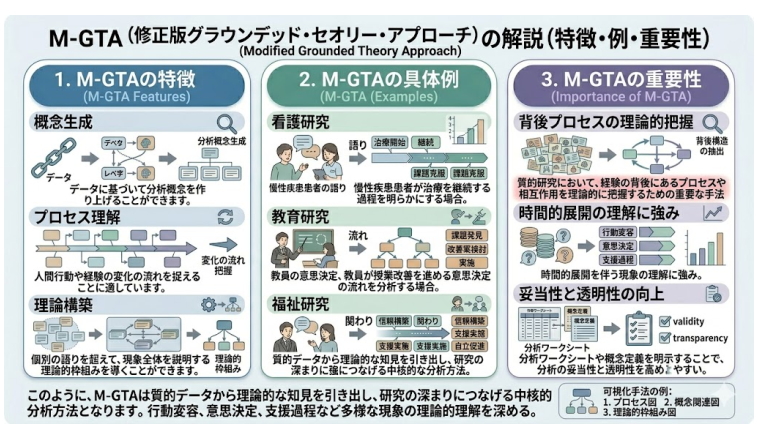
Characteristics of M-GTA
Concept generation: Analytical concepts can be developed from the data.
Process understanding: The method is well suited to capturing changes in human behavior and experience over time.
Theory building: It can move beyond individual narratives to derive a theoretical framework explaining the phenomenon as a whole.
Examples of M-GTA
Nursing research: Clarify the process through which patients with chronic illnesses continue treatment.
Educational research: Analyze teachers' decision-making as they work to improve instruction.
Welfare research: Organize how relationships between support providers and service users change over time.
Importance of M-GTA
M-GTA isan important qualitative method for theoretically understanding processes and interactions underlying experience.It is particularly strong for phenomena that unfold over time, such as behavioral change, decision-making, and support processes. Explicit use of analytical worksheets and concept definitions can also improve transparency and validity of the analysis.
Thus, M-GTA is a core method for deriving theoretical insight from qualitative data and deepening research understanding.
Contact Us
Over 30,000 consultations / Over 19,000 completed engagements. To date, we have supported consultations and requests involving analysis outsourcing, statistical processing, questionnaire surveys, marketing support, and more. Our experienced consultants carefully listen to your needs so that we can provide the right support. We offer prompt and accurate work at reasonable, accessible rates and are committed to delivering dependable results. Stat Agent team members across Japan will take responsibility for supporting you.
*We provide the profile of the person responsible for your project when you apply.
For outsourced analysis and statistical processing, choose Stat Agent.
0476-85-7930
*When order volume is high, it may be difficult to reach us by phone.
We apologize for the inconvenience. We respond in order of receipt, so if your matter is urgent, please contact us byemail .
*When order volume is high, it may be difficult to reach us by phone.
We apologize for the inconvenience. We respond in order of receipt, so if your matter is urgent, please contact us by
