
Multivariable Logistic Regression Support for Home End-of-Life Care Research at Medical Corporation HakuwakaiStatistical Analysis of the Association Between the Good Death Inventory (GDI) and Overall Satisfaction with End-of-Life Care
Using bereaved-family survey data on home end-of-life care, we examined associations between individual GDI items and satisfaction with end-of-life care using multivariable logistic regression.
Stat Agent supported a consultation from Medical Corporation Hakuwakai concerningstatistical and multivariable analysis for home end-of-life care research.The project involved questionnaire-survey data collected from bereaved family members of patients who had received home medical care, with the primary aim ofexamining the association between the Good Death Inventory (GDI) and overall satisfaction with end-of-life care using multivariable logistic regression.This was the central analytical objective.
According to the information shared at the time of consultation, a questionnaire survey was conducted with bereaved family members of 1,857 patients who had received home medical care and died between May 2020 and April 2024, and responses were obtained from the families of 867 patients. We also confirmed that the attached analytical dataset contained 867 records.
In consideration of research ethics and confidentiality, this article does not disclose individual patient information, specific analytical results, odds ratios, p-values, or unpublished research findings. It focuses instead on the publicly shareable consultation details and an overview of the analytical support.
Support OverviewFor Medical Corporation Hakuwakai's home end-of-life care study, we supported multivariable logistic regression using bereaved-family survey data from 867 respondents, with overall satisfaction with end-of-life care as the outcome and GDI-related items as explanatory variables. The purpose was to examine which GDI items remained associated with satisfaction after simultaneously accounting for the other items.
Overview of the Home End-of-Life Care Research Consultation
Research BackgroundThis consultation concerned research evaluating end-of-life care for patients who had received home medical care using assessments from bereaved family members. According to the consultation materials, a questionnaire survey was sent to the families of 1,857 patients who died between May 2020 and April 2024, and 867 responses were obtained. A simple calculation gives a response proportion of approximately 46.7%.
The central research question was which items of the Good Death Inventory (GDI) were associated with overall satisfaction with end-of-life care, assessed using multivariable analysis. By entering multiple GDI items into the model simultaneously, the association for each item can be evaluated while accounting for the influence of the other items.
| Item | Information Shared | Role in the Analysis |
|---|---|---|
| Survey Period | May 2020 to April 2024 | Bereaved-family survey of patients who received home medical care and died during the study period |
| Survey Population | Bereaved family members of 1,857 patients | Questionnaire survey |
| Number of Responses | 867 | The attached analytical dataset also contained 867 records. |
| Primary Assessment | Good Death Inventory (GDI) | GDI-related items examined as explanatory variables |
| Outcome Variable | Overall satisfaction with end-of-life care | Analyzed as a binary outcome using logistic regression |
| Analytical Method | Multivariable logistic regression | Associations examined while simultaneously accounting for multiple GDI-related items |
GDI-Related Items and Satisfaction with End-of-Life Care Confirmed in the Attached Data
Data ReviewThe attached Excel dataset contained 867 records excluding the header row and included GDI-related items in addition to a variable for satisfaction with end-of-life care. For the GDI-related variables, Question 1 was divided into three subitems—pain, physical suffering, and peacefulness—and, together with Questions 2 through 17, the analytical sheet contained 19 GDI-related columns.
The analytical dataset also contained codes of 0, 1, and 3. In multivariable logistic regression, it is therefore important to distinguish binary affirmative/non-affirmative information from nonresponse codes and confirm the coding system for both outcome and explanatory variables before analysis. In particular, missing responses should not be treated as ordinary category values; the handling of missingness must be clearly defined in the analytical plan.
| Category | Examples of Items in the Dataset | Points to Check During Analysis |
|---|---|---|
| Physical Dimension | Q1-1 “Pain” and Q1-2 “Physical suffering” | Confirm codes for affirmative, non-affirmative, and nonresponse values. |
| Psychological Dimension | Q1-3 “Peaceful feeling” and Q3 “Enjoyment” | Examine their independent associations with satisfaction with end-of-life care. |
| Care and Environment | Q2 “Preferred place,” Q7 “Environment,” and Q10 “Treatment accepted as appropriate” | Evaluate these within a model that includes multiple items simultaneously. |
| Relationships and Dignity | Q5 “Relationships” and Q8 “Treated as a valued person” | Assess associations after adjustment for other GDI-related items. |
| Life and Decision-Making | Q9 “Completed one's life,” Q12 “Things one wanted to communicate,” Q13 “Decisions about the future,” and related items | Interpret using the direction of coefficients, odds ratios, confidence intervals, and related measures. |
Why Use Multivariable Logistic Regression?
Logistic Regression AnalysisLogistic regression is a standard analytical method when the outcome is treated as binary, such as satisfied versus dissatisfied with end-of-life care. When there are multiple GDI evaluation items and the aim is to examine their associations with satisfaction simultaneously, multivariable logistic regression can be used to assess the independent association of each item while accounting for the others.
Simple cross-tabulation or separate comparisons for each item cannot account for relationships among the GDI items themselves. A multivariable model makes it possible to examine how a particular GDI item is associated with satisfaction when the other items are held constant.
| Item to Check | Main content | Research Significance |
|---|---|---|
| Outcome Variable | Specify overall satisfaction with end-of-life care as a binary outcome. | Clearly define what constitutes “satisfaction” in the model. |
| Explanatory variables | Include GDI-related items in the analytical model. | Examine the independent association between each item and satisfaction. |
| Missing / Nonresponse Data | Identify nonresponse codes and define how they are handled in the analysis. | Consider the potential influence of missing values on estimation and interpretation. |
| Model Estimation | Review regression coefficients, odds ratios, 95% confidence intervals, p-values, and related measures. | Evaluate the direction, magnitude, and uncertainty of associations. |
| Multivariable Interpretation | Estimation while simultaneously accounting for other GDI items | Examine independent associations that cannot be identified from univariable relationships alone. |
Important Data Preprocessing for Analysis of GDI and Satisfaction with End-of-Life Care
PreprocessingBefore entering data into statistical software for logistic regression, the coding of outcome and explanatory variables must be clearly defined. At the time of consultation, the coding shared for GDI was “affirmative = 1, non-affirmative = 0, no response = 3,” while satisfaction with end-of-life care was described as “satisfied = 1, dissatisfied = 2, no response = 3.” However, the “satisfaction with end-of-life care” column in the attached analytical sheet contained values 0, 1, and 3. Therefore, the coding definition provided at consultation must be reconciled with the actual analytical dataset before analysis.
Checking codes in this way is not merely data formatting; it is essential for avoiding misclassification of the outcome event. Because the handling of nonresponses may change the final analysis sample, the final number analyzed and the exclusion criteria should be stated clearly when reporting results.
Statistical Analysis Support for Home Healthcare and End-of-Life Care Research
Medical StatisticsResearch in home healthcare, home visits, end-of-life care, palliative care, and end-of-life decision-making may involve multidimensional information, including not only patient data but also evaluations by bereaved families, place of care, symptoms, decision-making, dignity, and family relationships. Depending on the research objectives, descriptive statistics, cross-tabulation, univariable analysis, multivariable logistic regression, and related methods may need to be combined appropriately.
In particular, when examining which factors among multiple candidates are independently associated with an outcome, it is important to build the analytical model while considering variable definitions, missing data, event counts, the number of explanatory variables, and stability of estimation.
Key Points When Incorporating Analytical Results into Medical Research and Manuscripts
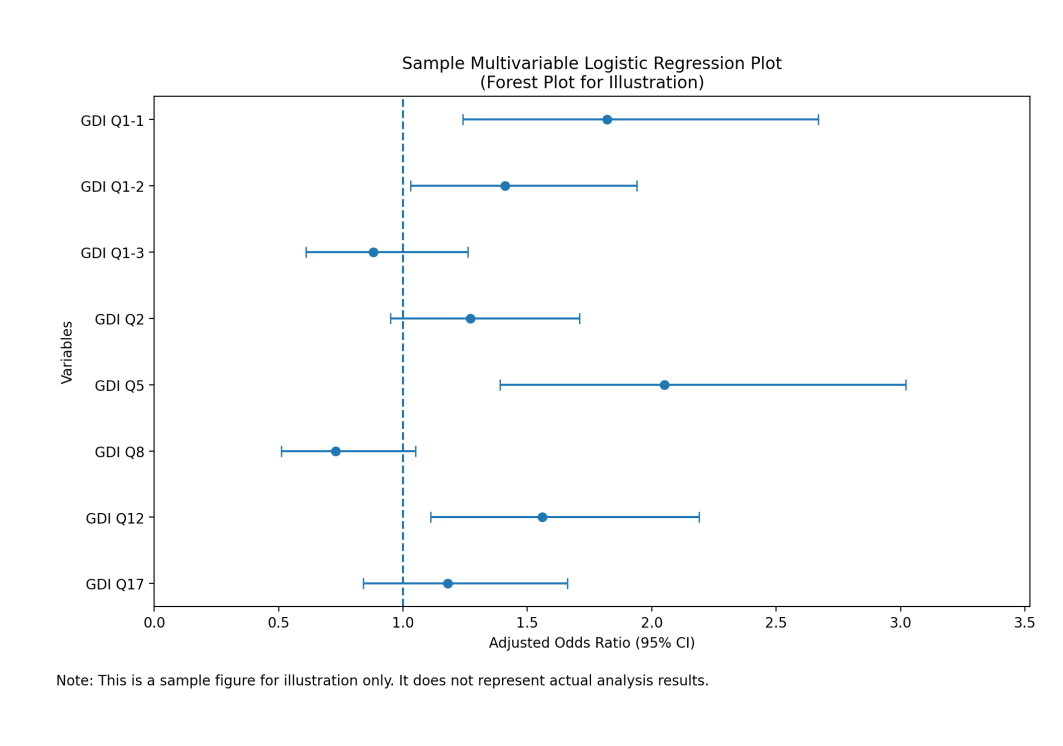
Results ReportingWhen reporting multivariable logistic regression in a paper or research report, the Methods section should state not only the name of the analytical method but also the definition of the outcome, specification of explanatory variables, handling of missing values, and number of observations analyzed. The Results section should organize odds ratios, 95% confidence intervals, p-values, and related information in a way that addresses the research objectives.
Even when a statistical association is identified, this alone does not establish causality. Findings should be interpreted in light of the study design and measurement methods without overgeneralization. In addition to conducting the analysis itself, Stat Agent supports organization of result tables and interpretation of statistical findings in relation to the research objectives.
SummaryFor Medical Corporation Hakuwakai's home end-of-life care study, we supported multivariable logistic regression using 867 bereaved-family responses from patients who received home medical care and died between May 2020 and April 2024. The analysis examined associations between individual Good Death Inventory (GDI) items and overall satisfaction with end-of-life care. This article does not disclose unpublished analytical results and instead focuses on the research objective, data structure, and analytical method.
Stat Agent's Multivariable Logistic Regression and Medical Statistics Support
Stat Agent provides statistical analysis support tailored to research objectives in medicine, nursing, home healthcare, palliative care, psychology, education, social sciences, and related fields, including logistic regression, multivariable analysis, multiple regression, and aggregation and analysis of questionnaire-survey data.
If you are unsure which variables should be specified as outcomes and explanatory variables, how to handle nonresponses or missing values, or how to organize logistic-regression results for a manuscript, we review your research objectives and data structure and help establish an appropriate analytical strategy.
Related Keywords
#MedicalCorporationHakuwakai #MultivariableLogisticRegression #HomeEndOfLifeCare #SatisfactionWithEndOfLifeCare #GDI #GoodDeathInventory #LogisticRegression #MultivariableAnalysis #HomeHealthcare #HomeMedicalCare #BereavedFamilySurvey #QuestionnaireSurvey #EndOfLifeCare #PalliativeCare #MedicalStatistics #StatisticalAnalysis #DataAnalysis #ResearchSupport #StatAgent
Publication policy: This article was prepared based on information shared by the client in the inquiry and on what could be confirmed from the provided analytical dataset. It does not disclose personally identifiable patient information, unpublished specific analytical results, odds ratios, p-values, or related findings.
Related Information 1:Statistical Analysis
Related Information 2:Consulting & Advisory
Related Information 3:Tabulation & Charting
Related Information 4:Report & Document Preparation
Related Information 5:Quotations / Contact
Contact Us
Over 30,000 consultations / Over 19,000 completed engagements. To date, we have supported consultations and requests involving analysis outsourcing, statistical processing, questionnaire surveys, marketing support, and more. Our experienced consultants carefully listen to your needs so that we can provide the right support. We offer prompt and accurate work at reasonable, accessible rates and are committed to delivering dependable results. Stat Agent team members across Japan will take responsibility for supporting you.
*We provide the profile of the person responsible for your project when you apply.
For outsourced analysis and statistical processing, choose Stat Agent.
*When order volume is high, it may be difficult to reach us by phone.
We apologize for the inconvenience. We respond in order of receipt, so if your matter is urgent, please contact us by
