
Yates’s Correction / Yates’s Continuity CorrectionYates's Correction for Continuity
(Japanese)Yates’s correction (Yates’s correction for continuity) is a correction method used primarily inchi-square tests for 2×2 contingency tables.With small samples, approximating discrete count data using the continuous chi-square distribution can make test results somewhat too likely to appear significant. Yates’s correction was developed to reduce this approximation error.
The correction adjusts each cell by subtracting0.5 from the absolute differencebetween the observed and expected frequencies before squaring it. This tends to produce a smaller chi-square statistic and therefore a larger p-value than the ordinary Pearson chi-square test. In other words, a test using Yates’s correction tends to be moreconservative.This is a characteristic feature of the correction.
The correction is often discussed for 2×2 tables with small expected counts and is widely introduced in introductory statistics materials and statistical software. On the other hand, when the sample is extremely small,Fisher’s exact testis now often selected instead. Yates’s correction is therefore frequently understood as occupying an intermediate position between an uncorrected chi-square test and an exact test. The method was proposed by statisticianFrank Yates Frank Yates in 1934.
In practice, use of the correction may be considered when “a 2×2 cross-tabulation has a small sample size” or “expected frequencies are not sufficiently large.” Whether to apply the correction varies by research field, software, and analytical policy, so when reporting results it is important tostate explicitly whether Yates’s correction was applied.This improves transparency of the analysis.
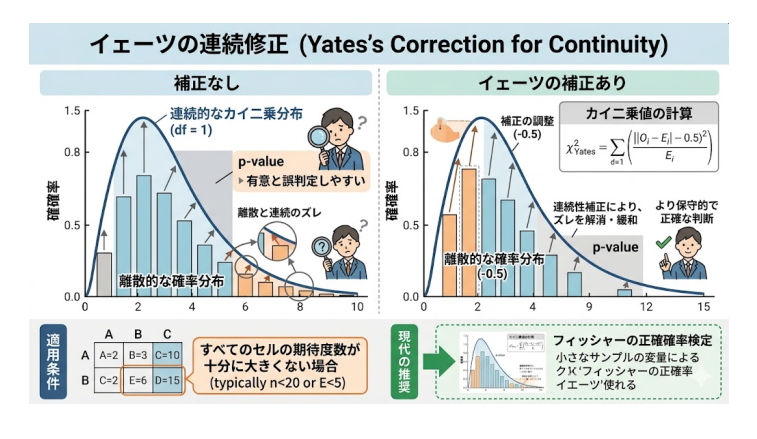
(English)
Yates's correction for continuity is a correction method used mainly in the chi-square test for 2×2 contingency tables. When the sample size is small, a continuous chi-square distribution is used to approximate discrete count data, and this approximation may overstate statistical significance. Yates's correction was proposed to reduce this approximation error.
In this correction, 0.5 is subtracted from the absolute difference between the observed frequency and the expected frequency before squaring. As a result, the corrected chi-square statistic tends to be smaller than the uncorrected Pearson chi-square statistic, and the p-value tends to be larger. In other words, Yates's correction generally makes the test more conservative.
This correction is commonly discussed when expected frequencies are small in a 2×2 table, and it is widely introduced in statistics textbooks and software output. On the other hand, when the sample size is very small, Fisher's exact test is often preferred in modern practice. For that reason, Yates's correction is often understood as an intermediate approach between the ordinary chi-square test and an exact test. The method was proposed by the statistician Frank Yates in 1934.
In practical analysis, the correction may be considered when a cross-tabulation involves two categories by two categories and the sample size is limited. However, whether the correction should be applied depends on the research field, the statistical software, and the analytic policy being used. Therefore, when reporting results, it is important to clearly state whether Yates's correction was applied.
Contact Us
Over 30,000 consultations / Over 19,000 completed engagements. To date, we have supported consultations and requests involving analysis outsourcing, statistical processing, questionnaire surveys, marketing support, and more. Our experienced consultants carefully listen to your needs so that we can provide the right support. We offer prompt and accurate work at reasonable, accessible rates and are committed to delivering dependable results. Stat Agent team members across Japan will take responsibility for supporting you.
*We provide the profile of the person responsible for your project when you apply.
For outsourced analysis and statistical processing, choose Stat Agent.
0476-85-7930
*When order volume is high, it may be difficult to reach us by phone.
We apologize for the inconvenience. We respond in order of receipt, so if your matter is urgent, please contact us byemail .
*When order volume is high, it may be difficult to reach us by phone.
We apologize for the inconvenience. We respond in order of receipt, so if your matter is urgent, please contact us by
