
イェーツの補正 / イェーツの連続修正Yates's Correction for Continuity
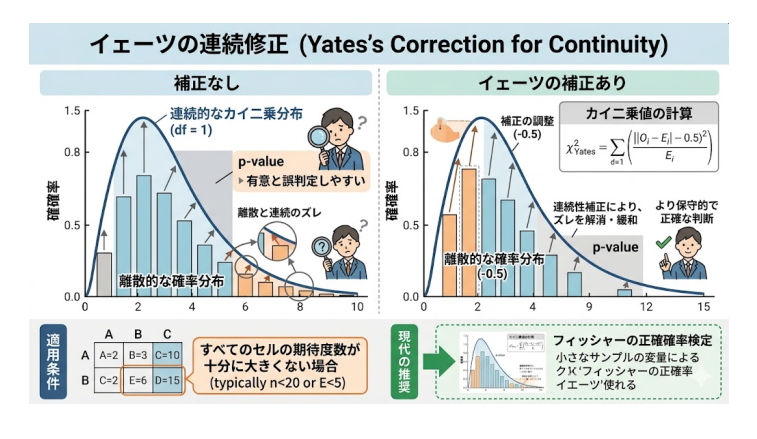
(日本語)イェーツの補正(イェーツの連続修正、英: Yates's correction for continuity)とは、主として2×2分割表に対するカイ二乗検定において用いられる補正方法である。小標本の場合、離散的な度数データに対して連続分布であるカイ二乗分布を近似的に用いると、検定結果がやや過大に有意になってしまうことがある。そこで、その近似誤差を小さくするために考案されたのがイェーツの補正である。
この補正では、各セルについて「観測度数と期待度数の差の絶対値」から0.5を差し引いてから二乗するという調整を行う。これにより、通常のカイ二乗値よりも値が小さくなりやすく、結果としてp値は大きくなりやすい。すなわち、イェーツの補正を用いた検定は、補正なしのPearsonのカイ二乗検定よりも保守的な判定になりやすいという特徴がある。
特に、期待度数が小さい2×2表ではしばしば言及される補正であり、統計学の初学者向け教材や統計ソフトでも広く紹介されている。一方で、標本数が極めて少ない場合には、近年ではFisherの正確確率検定が選ばれることも多い。そのため、イェーツの補正は「補正なしのカイ二乗検定」と「正確検定」の中間的な位置づけとして理解されることが多い。なお、この方法は統計学者Frank Yates により1934年に提案された。
実務上は、「2群×2群のクロス集計でサンプルサイズが小さい」「期待度数が十分に大きいとは言いにくい」といった場面で、補正の適用を検討する。もっとも、補正を行うかどうかは研究分野や使用ソフト、分析方針によって異なるため、結果を報告する際にはイェーツの補正を適用したかどうかを明記することが重要である。
(英語)
Yates's correction for continuity is a correction method used mainly in the chi-square test for 2×2 contingency tables. When the sample size is small, a continuous chi-square distribution is used to approximate discrete count data, and this approximation may overstate statistical significance. Yates's correction was proposed to reduce this approximation error.
In this correction, 0.5 is subtracted from the absolute difference between the observed frequency and the expected frequency before squaring. As a result, the corrected chi-square statistic tends to be smaller than the uncorrected Pearson chi-square statistic, and the p-value tends to be larger. In other words, Yates's correction generally makes the test more conservative.
This correction is commonly discussed when expected frequencies are small in a 2×2 table, and it is widely introduced in statistics textbooks and software output. On the other hand, when the sample size is very small, Fisher's exact test is often preferred in modern practice. For that reason, Yates's correction is often understood as an intermediate approach between the ordinary chi-square test and an exact test. The method was proposed by the statistician Frank Yates in 1934.
In practical analysis, the correction may be considered when a cross-tabulation involves two categories by two categories and the sample size is limited. However, whether the correction should be applied depends on the research field, the statistical software, and the analytic policy being used. Therefore, when reporting results, it is important to clearly state whether Yates's correction was applied.
お問い合わせ
累計相談実績30,000件以上/正式受託実績19,000件以上。これまで(分析代行・統計処理・アンケート調査・マーケティング支援など)のご相談・ご依頼をサポートしてきました。経験豊富な相談員があなたのご要望にお応えする為、親身になってヒアリングをいたします。負担の軽い納得料金で、迅速・的確な作成を行い、成果を確実にお約束いたします。全国にいるスタットエージェントメンバーが責任を持ってお客様をサポート致します!
※お申込み時に担当責任者のプロフィールを送付致しております!
分析代行・統計処理ならスタットエージェント!
