
How to Conduct Thematic Analysis in PracticeThematic Analysis
Major Steps in Practical Thematic Analysis
This section explains how thematic analysis is conducted in qualitative research. Thematic analysis isa method for identifying recurring units of meaning and important topics in qualitative data such as interview transcripts, open-ended responses, and observation records, and organizing and interpreting them as themes.Because it can clarify characteristics of experiences, perceptions, emotions, values, and behaviors that cannot be fully captured by numerical comparison, thematic analysis is widely used in nursing, education, welfare, psychology, marketing research, human-resource research, and many other fields. Although thematic analysis is relatively flexible and practical, following a careful analytical process can support trustworthy qualitative research.How to Conduct Thematic Analysis in Practice
Practical thematic analysis involves several important steps depending on the analytical objective and characteristics of the data. Each is explained below.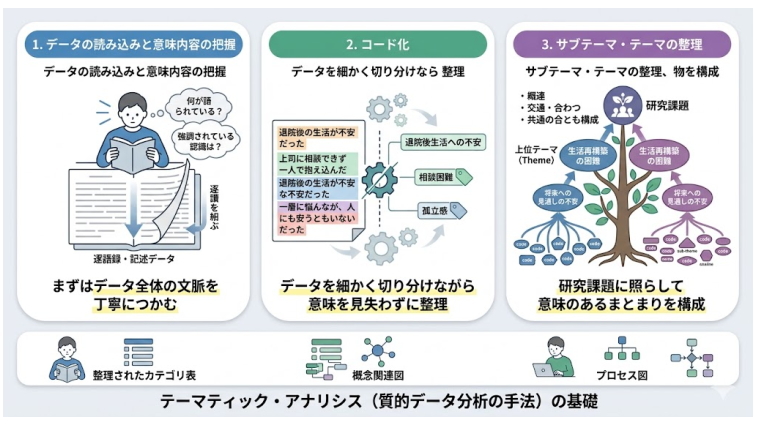
1. Familiarization with the Data and Understanding Meaning:
In thematic analysis, the first step is to read interview transcripts or open-ended data repeatedly to understand the overall flow and meaning. This involves more than simply reading the text; the analyst becomes familiar with the data while asking what is repeatedly discussed, which experiences or perceptions are emphasized, and which passages relate to the research question. If familiarization is superficial, later coding and theme development can also remain superficial. Therefore,carefully understanding the context of the dataset as a wholeis the foundation of qualitative data analysis.
2. Coding:
Next, meaningful portions of the data are identified and given short labels or phrases. This is coding. For example, a statement such as “I was worried about life after discharge” might be coded as “anxiety about life after discharge,” while “I could not talk to my supervisor and kept everything to myself” might be coded as “difficulty seeking consultation” or “sense of isolation.” Codes may stay close to participants' own language or may be somewhat more abstracted by the researcher. In this step, it is important todivide the data into manageable units while preserving their meaning..
3. Organizing Subthemes and Themes:
Once coding has progressed, similar and related codes are grouped into subthemes and themes. For example, codes such as “anxiety,” “confusion,” and “uncertainty about what comes next” might be grouped into a subtheme such as “uncertainty about the future,” and then integrated into a broader theme such as “difficulty reconstructing daily life.” This process requires considering relationships, similarities, and differences among codes and asking what broader structure of meaning emerges. Rather than stopping at simple classification, it is important toconstruct meaningful groupings in relation to the research question..
Unlike quantitative statistical analysis, thematic analysis enables deep understanding of experiences and perceptions that are difficult to express numerically. Familiarization supports contextual understanding, coding breaks meaning into analyzable units, and theme development provides structure. Appropriate interpretation should be added according to the research objective. Code lists, theme maps, concept diagrams, and category tables are often used to visualize thematic-analysis findings.
Familiarization with the Data and Understanding Meaning
Familiarization with the data is the first stage of thematic analysis and an important process that affects the quality of the entire analysis. Interview transcripts, open-ended responses, observation notes, and similar data are reread repeatedly to understand the overall flow, distinctive features of narratives, memorable expressions, and contextually important background. This initial reading is essential in qualitative research across medicine, nursing, education, welfare, management, and other fields.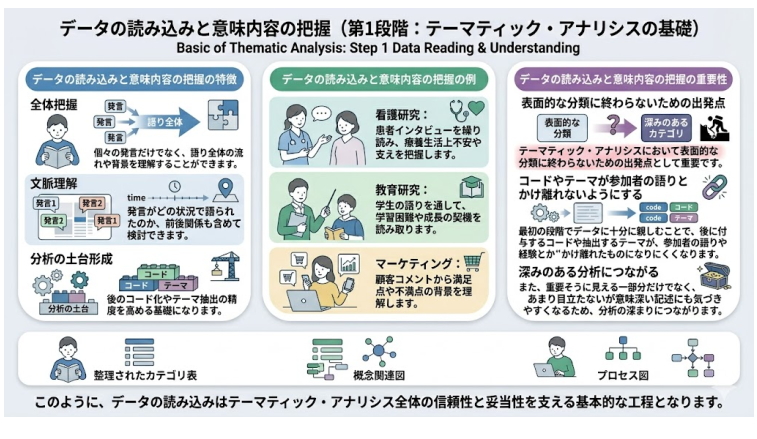
Characteristics of Data Familiarization and Meaning Review
Holistic understanding: The analyst can understand not only individual statements but also the overall flow and background of narratives.
Contextual understanding: Statements can be examined in relation to the circumstances and surrounding text in which they were made.
Foundation for analysis: Familiarization improves the accuracy of later coding and theme development.
Examples of Data Familiarization and Meaning Review
Nursing research: Repeatedly read patient interviews to understand anxieties and sources of support in daily life with illness.
Educational research: Read students' narratives to identify learning difficulties and triggers for growth.
Marketing: Understand the background behind points of satisfaction and dissatisfaction in customer comments.
Importance of Data Familiarization and Meaning Review
Familiarization with the data isthe starting point for preventing thematic analysis from becoming merely superficial classification.Becoming sufficiently familiar with the data at the beginning reduces the risk that later codes and themes will drift away from participants' narratives and experiences. It also makes it easier to notice less conspicuous but meaningful passages rather than focusing only on obviously important statements, deepening the analysis.
Thus, data familiarization is a fundamental step supporting the trustworthiness and validity of thematic analysis as a whole.
Coding
Coding is the process of extracting meaningful portions of qualitative data and assigning each a short label. It is a central task in thematic analysis and helps organize similarities and differences that are difficult to see by simply reading the raw data.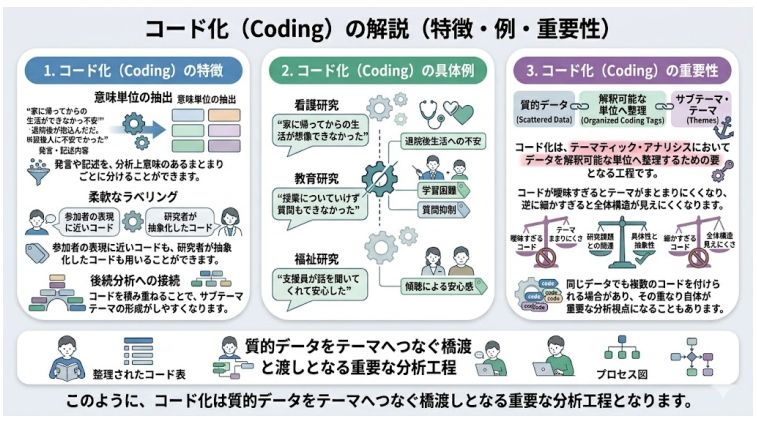
Characteristics of Coding
Extraction of meaning units: Statements and written passages can be divided into units that are meaningful for analysis.
Flexible labeling: Codes may closely reflect participants' expressions or may be more abstract labels developed by the researcher.
Link to subsequent analysis: Accumulating codes makes it easier to develop subthemes and themes.
Examples of Coding
Nursing research: Code the statement “I could not imagine what life would be like after going home” as “anxiety about life after discharge.”
Educational research: Code “I could not keep up with the class and could not ask questions” as “learning difficulty” and “inhibition of asking questions.”
Welfare research: Code “I felt relieved because the support worker listened to me” as “reassurance through attentive listening.”
Importance of Coding
Coding isa key process for organizing qualitative data into interpretable units in thematic analysis.If codes are too vague, themes can be difficult to develop; if they are too detailed, the broader structure can become hard to see. Codes should therefore balance specificity and abstraction while maintaining relevance to the research question. The same passage may also appropriately receive multiple codes, and that overlap itself can become an important analytical perspective.
Thus, coding is an important bridge connecting qualitative data to themes.
Organizing Subthemes and Themes
Organizing subthemes and themes is the process of comparing and integrating coded content to clarify the overall structure of the qualitative data. In thematic analysis, this is the stage at which the central interpretation of the study begins to take shape.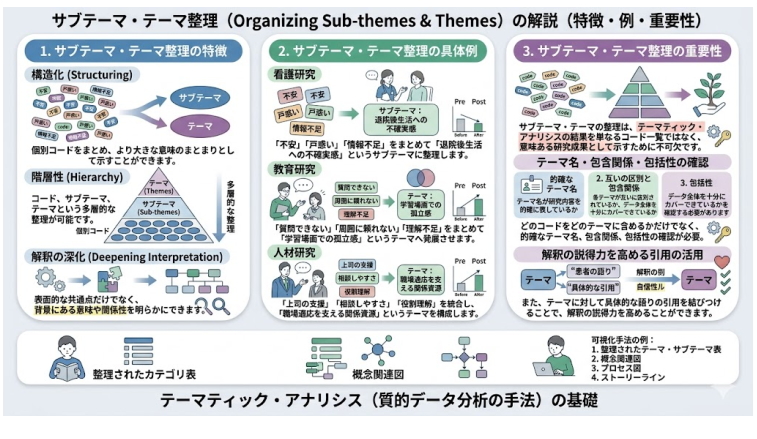
Characteristics of Subtheme and Theme Development
Structuring: Individual codes can be grouped and presented as broader units of meaning.
Hierarchy: Codes, subthemes, and themes can be organized at multiple levels.
Deeper interpretation: The process can reveal not only surface similarities but also underlying meanings and relationships.
Examples of Subtheme and Theme Development
Nursing research: Combine “anxiety,” “confusion,” and “lack of information” into the subtheme “uncertainty about life after discharge.”
Educational research: Combine “unable to ask questions,” “unable to rely on others,” and “insufficient understanding” into a theme such as “sense of isolation in learning situations.”
Human-resource research: Integrate “supervisor support,” “ease of consultation,” and “role understanding” into a theme such as “relational resources supporting workplace adjustment.”
Importance of Subtheme and Theme Development
Organizing subthemes and themes isessential for presenting thematic-analysis findings as meaningful research results rather than merely a list of codes.This stage requires checking not only which codes belong under which themes, but also whether theme names accurately represent the content, whether themes are sufficiently distinct from one another, and whether they adequately cover the dataset. Linking themes to concrete quotations can further strengthen the persuasiveness of the interpretation.
Thus, organizing subthemes and themes is a core step for clarifying the meaning structure of qualitative data and presenting it in a form readers can understand.
Contact Us
Over 30,000 consultations / Over 19,000 completed engagements. To date, we have supported consultations and requests involving analysis outsourcing, statistical processing, questionnaire surveys, marketing support, and more. Our experienced consultants carefully listen to your needs so that we can provide the right support. We offer prompt and accurate work at reasonable, accessible rates and are committed to delivering dependable results. Stat Agent team members across Japan will take responsibility for supporting you.
*We provide the profile of the person responsible for your project when you apply.
For outsourced analysis and statistical processing, choose Stat Agent.
0476-85-7930
*When order volume is high, it may be difficult to reach us by phone.
We apologize for the inconvenience. We respond in order of receipt, so if your matter is urgent, please contact us byemail .
*When order volume is high, it may be difficult to reach us by phone.
We apologize for the inconvenience. We respond in order of receipt, so if your matter is urgent, please contact us by
